California state income tax
One formula instead of ten brackets
Today California taxes income in ten steps, like a ladder. This page replaces the ladder with a smooth ramp set by one simple formula, keeps it in step with prices automatically, and taxes gains that rich people borrow against instead of selling.
Before 2026 brackets
After one smooth formula
Single filer, taxable income, log scale (each mark is ten times the last). Today's step points follow published 2026 tables, which differ slightly by source. With the default settings (26% and $195,000), a static estimate from FTB tax-year 2022 data raises about 30% more income tax, roughly $45 billion a year. Setting 18% and $150,000 is roughly revenue-neutral.
The formula
rate on next dollar = 26% × income ÷ (income + $195,000)
Total tax works out to top rate × (income − halfway × ln(1 + income ÷ halfway)), so the Franchise Tax Board can still print a lookup table for people who file on paper.
Two numbers set the whole tax. There are no steps, so no one ever lands just past a line, and a raise always means a slightly higher rate on the extra money, never a jump. A person with low income pays almost nothing. The rate climbs fastest in the middle and slowly approaches the top rate for the very richest.
Keeping up with prices
Today the state adjusts each bracket every year for inflation, using the California Consumer Price Index from June to June. With the formula, the state adjusts only one number: the halfway income.
halfway income this year = $195,000 × (CCPI this June ÷ CCPI June 2026)
Because the formula only uses income divided by the halfway income, moving that one number shifts the whole ramp at once. If prices rise 3%, the halfway income becomes $200,850, and someone whose pay also rose 3% pays the same share as before. The top rate never changes unless lawmakers or voters change it. A state could instead tie the halfway income to median wages, so that real raises do not slowly push people up the ramp.
What it pays for
Even after this year's budget, the Legislative Analyst's Office expects California to spend $8 billion to $10 billion a year more than it collects through 2029–30. The federal H.R. 1 law also shifts food aid and health costs to the state. Keeping CalFresh food benefits whole costs about $4 billion a year, and undoing the planned Medi-Cal cuts to immigrant coverage and community clinics costs about $4 billion more.
- Close the deficit: about $10 billion a year
- Keep CalFresh whole: about $4 billion a year
- Restore Medi-Cal coverage and clinic payments: about $4 billion a year
- Build 90,000 more affordable homes a year: about $15 billion a year
- Schools and community colleges: about $12 billion a year
- Total: about $45 billion a year
Over ten years, 900,000 more homes would mean about 6% more homes in the state. Based on the Legislative Analyst's estimates, that would leave rents about 3% lower and home prices about 7% lower than otherwise. For a renter paying the median California rent of $2,104 a month, that is about $760 a year saved.
Estimate assumes no change in behavior and counts nothing from taxing borrowed gains, which would add more.
Gains you borrow against
Very rich people often never sell their stock. Instead they borrow against it, live on the loans, and pass the stock on at death, when the untaxed gain is wiped out. If you can spend the gain by borrowing against it, you can pay tax on it. One way to do that:
- When you borrow against stock or property that has gone up in value, the amount you borrow counts as income that year, up to your untaxed gain.
- The first $250,000 a year per person is free (indexed like the halfway income), so ordinary borrowing is not affected.
- Home loans on your main home, student loans, car loans, and credit cards do not count.
- The gain you paid tax on is marked as taxed, so you never pay twice when you later sell.
- The counted amount goes through the same formula as any other income.
This matches one of three options studied by the Yale Budget Lab for the federal tax. The other two are a 10% withholding on such loans, credited later, and a small yearly charge on the loan balance.
Try an income
Borrowed amounts count only above the $250,000 free amount, and only up to the untaxed gain (this calculator assumes the gain is at least that large).
Why this matters
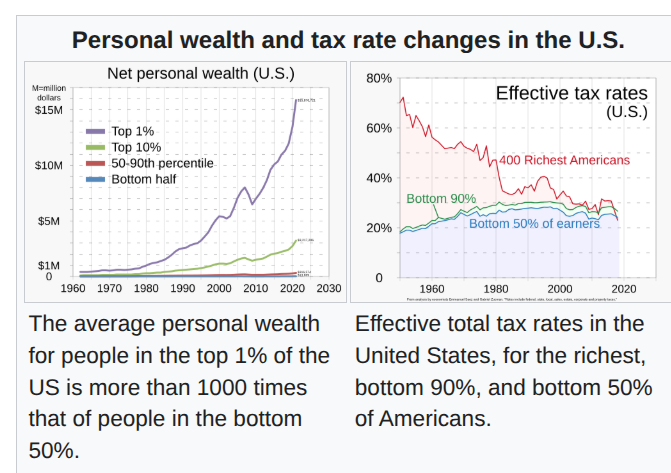
Across the U.S., the richest people have pulled far ahead in wealth, mostly as gains they never sell. At the same time, the share of income they pay in total taxes has fallen to about what everyone else pays. A smooth ramp that keeps rising at the top, plus a tax on borrowed gains, reaches the money that today's ladder misses.
What critics say
California already has the highest top state income tax rate in the country, and critics say higher rates push high earners to move away. They also say a loan is not income because it must be paid back, that the rule needs the value and purchase price of every asset at the time of borrowing, and that people could move out of state before they borrow. Leaning on a few very rich people also makes the state budget swing with the stock market. Studies disagree on how many people actually move because of taxes.
Sources: FTB on indexing, Yale Budget Lab on borrowing against gains, 2026 California brackets, LAO 2026-27 spending plan, LAO on H.R. 1 CalFresh changes, FTB income distribution data, LAO on housing costs, California Housing Partnership 2026, Enterprise pipeline brief.
Send your own letter
You can send this same request to your own representatives. The letter below is a template: fill in every highlighted field before you send it.
- Find your representatives at findyourrep.legislature.ca.gov. Enter your home address and note your Assemblymember and State Senator and their district numbers.
- Look up their Capitol suite numbers and email addresses in the Secretary of State's rosters for the Assembly and the Senate. Assembly addresses usually look like assemblymember.lastname@asm.ca.gov, and Senate addresses like senator.lastname@senate.ca.gov, but check the roster.
- Copy the letter into your email program and replace each highlighted field. If your Assemblymember is Chair Gipson or your Senator is Chair McNerney, delete the duplicate address block. If your own legislator lost yesterday's election, delete the congratulations sentence.
- Add one or two sentences of your own about how taxes, food aid, health coverage, or housing costs affect you. A personal line gets more attention than a form letter.
- Save the two figures in the letter (right-click or long-press each image) and insert them inline where they appear, or attach them.
- Email it to your two legislators and the two committee chairs, and copy the Governor's staff, using the lists below.
- Paste the text into the Governor's form at gov.ca.gov/contact, which accepts no attachments, and into Governor-Elect Becerra's form at xavierbecerragovernor.com/contact-us.
- For extra weight, print the letter from your email program and mail it to the Capitol addresses shown.
Committee chairs are reassigned when the Legislature reorganizes in December 2026. Before sending in 2027, check the Assembly and Senate Revenue and Taxation committee pages.
Subject line
Constituent request: replace income tax brackets with one indexed formula and tax borrowing against unrealized gains
To (add your own two legislators)
assemblymember.gipson@asm.ca.gov, senator.mcnerney@senate.ca.gov
Cc
nathan.barankin@gov.ca.gov, christine.aurre@gov.ca.gov, joe.stephenshaw@dof.ca.gov
[Your full name]
[Street address]
[City], CA [ZIP]
[Your email]
[Your phone number]
[Date]
The Honorable [Your Assemblymember]
Member, California State Assembly, [number] District
1021 O Street, Suite [number]
Sacramento, CA 95814
Email: [assemblymember email]
The Honorable [Your State Senator]
Member, California State Senate, [number] District
1021 O Street, Suite [number]
Sacramento, CA 95814
Email: [senator email]
The Honorable Mike A. Gipson
Chair, Assembly Committee on Revenue and Taxation
Member, California State Assembly, 65th District
1021 O Street, Suite 6210
Sacramento, CA 95814
Email: assemblymember.gipson@asm.ca.gov
The Honorable Jerry McNerney
Chair, Senate Committee on Revenue and Taxation
Member, California State Senate, 5th District
1021 O Street, Suite 6640
Sacramento, CA 95814
Email: senator.mcnerney@senate.ca.gov
The Honorable Gavin Newsom
Governor of California
Nathan Barankin, Chief of Staff, nathan.barankin@gov.ca.gov
Christine Aurre, Legislative Affairs Secretary, christine.aurre@gov.ca.gov
Luke Reidenbach, Chief Deputy Legislative Secretary (Revenue and Taxation)
Joe Stephenshaw, Director of Finance, joe.stephenshaw@dof.ca.gov
1021 O Street, Suite 9000
Sacramento, CA 95814
ALSO BY ELECTRONIC COPY TO gov.ca.gov/contact
The Honorable Xavier Becerra
Governor-Elect of California
BY ELECTRONIC COPY TO xavierbecerragovernor.com/contact-us
Re: Request for legislation replacing the personal income tax brackets with a single indexed rate formula and taxing borrowing against unrealized gains
Dear Assemblymember [last name], Senator [last name], Chair Gipson, Chair McNerney, Governor Newsom, and Governor-Elect Becerra:
Congratulations on your and your coalition's victory in yesterday's election! I am a constituent of Assemblymember [last name] and Senator [last name] in [City], and I respectfully ask each of you to introduce, co-author, and support legislation in the 2027–28 session that makes three changes to the California personal income tax. I would also ask the Governor's office and the incoming administration to request estimates from the Franchise Tax Board and the Legislative Analyst's Office so the changes can be calibrated before introduction.
The problem. As Figure 1 shows, economists Emmanuel Saez and Gabriel Zucman estimate that the effective total tax rate paid by the 400 richest Americans has fallen from about 70 percent in 1950 to roughly the rate paid by the bottom half of earners, while the wealth of the top 1 percent has grown to more than 1,000 times that of the bottom half. California's own schedule has ten brackets with uneven spacing. For a single filer, one 9.3 percent bracket runs from about $70,600 to about $360,700, so a teacher and a senior executive face the same marginal rate, and the schedule stops rising at $1 million. The 10.3 to 12.3 percent rates also face expiration after 2030 unless voters or the Legislature act.
|
Figure 1. U.S. wealth and effective tax rates. Image: Wikipedia; tax-rate analysis by Emmanuel Saez and Gabriel Zucman. |
Request 1: One continuous rate formula in place of the brackets. I propose (see Figure 2) that the marginal rate on each additional dollar of taxable income y be:
rate = R × y ÷ (y + M)
Here R is the top rate and M is the "halfway income," where the rate is half of R. Total tax has an exact closed form, R × (y − M × ln(1 + y ÷ M)), so the FTB can still publish tables. Joint filers would use 2M, matching current practice of doubling brackets. There are no cliffs or flat stretches, and every raise is taxed at a slightly higher rate rather than a jump. With R = 18 percent and M = $150,000, the formula is roughly revenue-neutral. To meet the needs described below, I propose R = 26 percent and M = $195,000. Every single filer with taxable income below about $168,000 (about twice that for joint filers) would pay less tax than today: about $5,011 instead of $5,842 at $100,000. Counting the housing savings described below, a renter paying the median rent would come out ahead up to about $192,000. Filers above that would pay more: about $168,086 instead of $104,395 at $1 million, and about $2.4 million instead of $1.3 million at $10 million. I ask that the FTB and LAO score these settings, including behavioral responses, before introduction.
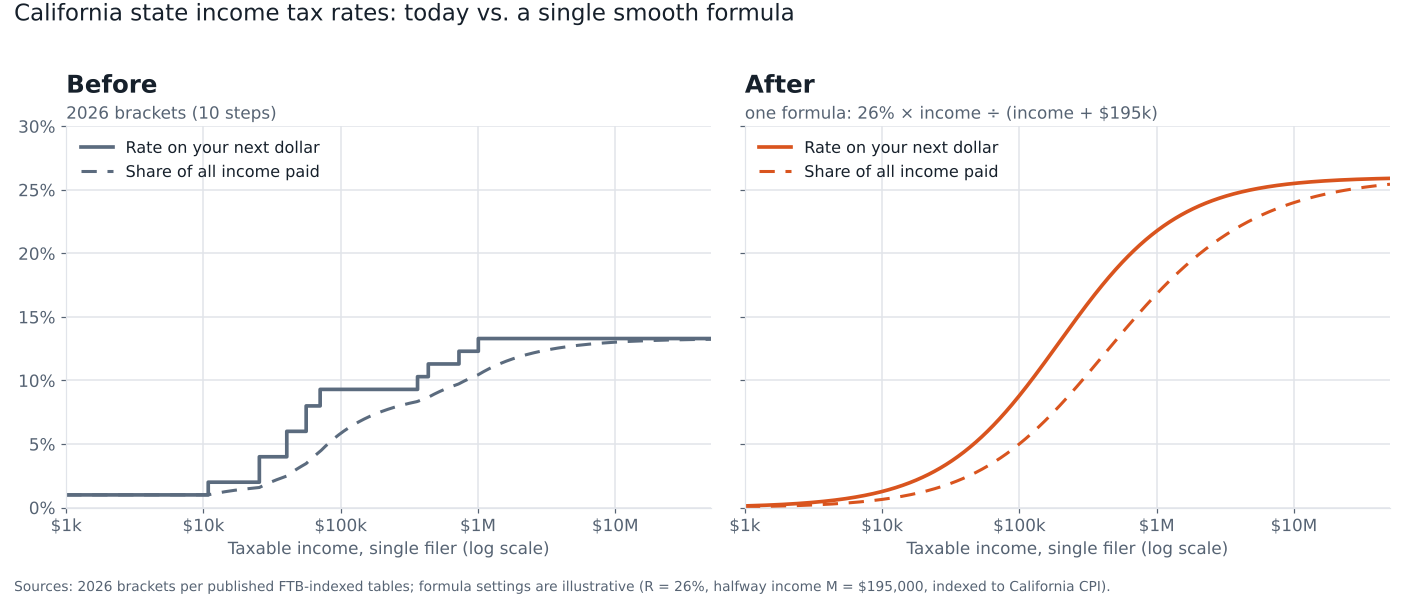
Figure 2. California rates today and under the proposed formula (proposed R = 26%, M = $195,000). Solid lines show the rate on the next dollar; dashed lines show the share of all income paid. |
Request 2: Automatic indexing of one number. Each year, M would be multiplied by the ratio of the California Consumer Price Index for June of that year to June 2026, the same June-to-June measure the FTB already uses for bracket indexing. Because the formula depends only on y divided by M, this single adjustment keeps the whole schedule constant in real terms. The rate R would change only by legislation or vote. I would also welcome analysis of indexing M to California median wages instead, which would keep real wage growth from moving households up the schedule.
Request 3: Tax gains that are borrowed against. Many of the wealthiest households avoid tax by holding appreciated assets, borrowing against them to fund consumption, and passing them on at death, when the gain is erased. If a gain can be spent through a loan, it can bear tax. I propose that loans secured by appreciated assets be treated as realizing gain, up to the borrower's untaxed gain, above an exemption of $250,000 per person per year indexed with M. Mortgages on a primary residence, student loans, auto loans, and credit cards would be excluded. The amount taxed would be added to basis so the same gain is never taxed twice, and the counted amount would pass through the same rate formula as other income. This follows the deemed realization option analyzed by the Yale Budget Lab for federal reform, and California already taxes capital gains as ordinary income, so the change fits our system. Rules on part-year residents and out-of-state lenders would be needed to prevent avoidance.
What this would pay for. Even after this year's budget, the Legislative Analyst's Office projects operating deficits of $10.4 billion in 2027–28, $8.7 billion in 2028–29, and $8.3 billion in 2029–30, and it has recommended at least $10 billion in ongoing solutions. Those figures do not restore what H.R. 1 takes away. For CalFresh, the state's share of administrative costs rose in October 2026, adding about $480 million a year, and starting in October 2027 the state must pay up to 15 percent of benefits, about $2 billion a year at our recent error rate of nearly 11 percent. Keeping benefits whole for families cut by the new work-time limits and eligibility rules brings the CalFresh need to about $4 billion a year, within the Department of Social Services' estimate of $2.3 to $5.1 billion in lost federal CalFresh funding. For Medi-Cal, the enacted budget saves about $3 billion a year by 2029–30 by restricting coverage for immigrants, cuts community clinic payments by about $1 billion starting July 2027, ends adult dental benefits, and lowers the asset limit, and the administration expects 1.3 million people to leave Medi-Cal by 2029–30. Restoring the immigrant coverage and clinic payments alone costs about $4 billion a year.
The same revenue can make housing cheaper. California funded about 23,400 new affordable homes in 2025, about a fifth of the Roadmap Home goal of 119,287 a year, and nearly 40,000 shovel-ready affordable homes are waiting for money. State subsidy averages about $170,000 per affordable rental home, so funding 90,000 more each year would cost about $15 billion a year. That is the midpoint of the 70,000 to 110,000 additional homes a year that the LAO estimated California would have needed to keep its home prices rising no faster than the nation's. Over ten years it would add about 900,000 homes, or 6 percent more than the state's 14.9 million. Based on the LAO's estimates of how housing demand and rents respond to supply, I estimate home prices would be about 7 percent lower and rents about 3 percent lower than otherwise. For a renter paying the state median of $2,104 a month, that saves about $760 a year, and the households who move into the new homes would save far more. I propose that the housing share go to a dedicated fund, as the Proposition 63 mental health surcharge does, so it is spent only on housing.
| Close the projected operating deficit | $10 billion |
| Keep CalFresh benefits whole | $4 billion |
| Restore Medi-Cal immigrant coverage and clinic payments | $4 billion |
| Build 90,000 more affordable homes each year | $15 billion |
| Schools and community colleges | $12 billion |
| New revenue needed each year | $45 billion |
I applied the formula to the FTB's most recent published distribution of returns by income (tax year 2022, adjusted to current bracket dollars). Schools and community colleges receive about 40 percent of new General Fund revenue under the constitution; I assume the dedicated housing fund is not counted. With R = 26 percent and M = $195,000, personal income tax liability rises about 30 percent, or roughly $45 billion of the LAO's $149.6 billion personal income tax forecast for 2028–29. This is a static estimate that assumes no change in behavior, and it counts nothing from taxing borrowed gains under Request 3, which would add revenue the FTB should estimate separately. Part of the new CalFresh cost may already be counted in the LAO deficit, so the $45 billion target may be somewhat higher than strictly needed; any excess should go to the Rainy Day Fund.
Concerns I take seriously. Opponents argue that higher top rates encourage high earners to leave, that a loan is not income because it must be repaid, that valuing assets at the time of borrowing is burdensome, and that reliance on a small number of taxpayers makes revenue volatile. Housing skeptics add that slower price growth reduces existing owners' gains, and that a nearly fivefold increase in subsidized building could exceed federal tax-credit and bond limits and construction capacity, raising the cost per home. Research on tax-motivated migration does not agree on the size of the effect. I ask that the LAO analysis address each of these, and that the new rates phase in over two years so revenue and migration can be measured.
Chair Gipson and Chair McNerney, I respectfully ask that your committees hold an informational hearing on these proposals early in the 2027–28 session, with testimony from the FTB and the LAO.
Governor-Elect Becerra, during the campaign you pledged to review tax code changes to offset federal health care cuts. I hope you will include this proposal in that review. Governor Newsom, I ask that your office help the incoming administration by requesting the FTB and Department of Finance estimates now, before the 2027–28 budget is drafted.
An interactive version with charts, adjustable R and M, and a calculator for any income is available here: California Tax Ladder.
Thank you for your consideration. I would be glad to meet with your staff and would appreciate a written reply stating your position.
Respectfully,
[Your full name]
Constituent, Assembly District [number] and Senate District [number]
[Your email]
[Your phone number]